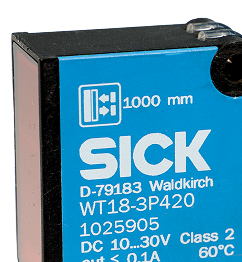
What type of sensor is this?
This is a compact photoelectric proximity sensor with background suppression, designed to detect objects using reflected visible red light.
What is the adjustable sensing range?
The sensing range can be adjusted from 10 mm to 180 mm. The maximum specified detection range is 4 mm to 180 mm when measured against an object with 90% reflectivity.
How is the sensing distance adjusted?
The detection distance is configured using a five-turn potentiometer on the sensor housing, allowing precise adjustment for the application.
What type of light source does the sensor use?
The sensor uses a SICK PinPoint LED that emits visible red light at a wavelength of 650 nm.
What electrical supply does it require?
The WTB4S-3P2261 operates from a 10 V DC to 30 V DC supply and has a typical current consumption of 20 mA without a connected load.
What type of output does the sensor provide?
It provides complementary PNP digital outputs with light and dark switching. The maximum permitted output current is 100 mA.
How quickly can the sensor detect an object?
The sensor has a response time of less than 0.5 ms and supports a switching frequency of up to 1,000 Hz, making it suitable for fast-moving production processes.
What connector is required?
The sensor has a straight M8, four-pin male connector. A compatible M8, four-pin female sensor cable is required for installation.
What do the connector pins do?
Pin 1, brown, connects to positive supply voltage; pin 3, blue, connects to supply common; and pins 2 and 4 provide the complementary switching outputs.
What are the sensor's dimensions and weight?
The rectangular slim housing measures 12.2 mm wide, 41.8 mm high and 17.3 mm deep. The unit weighs approximately 30 g.
What environmental protection does the housing provide?
The housing is rated to both IP66 and IP67, providing protection against dust, powerful water jets and temporary immersion under the conditions defined by the relevant ratings.
What temperature range can it operate within?
The specified operating temperature range is -40°C to +60°C. The permitted storage temperature range is -40°C to +75°C.
What materials are used in the housing?
The main housing is manufactured from ABS plastic, while the front optical screen is made from PMMA plastic.
What is background suppression?
Background suppression enables the sensor to distinguish the target object from surfaces located behind it. This helps reduce unwanted switching caused by machinery panels, conveyor structures or other nearby backgrounds.
Does object colour affect detection performance?
Object colour and surface reflectivity can influence detection. Dark or low-reflectivity targets generally return less light than white targets, so the sensor should be aligned and adjusted using the actual object and installation conditions.
What is the light spot size?
The emitted light spot has a diameter of approximately 6.5 mm at a distance of 150 mm, supporting accurate detection of relatively small objects.
How is the sensor mounted?
The housing includes M3 threaded mounting holes. It can be installed directly or used with a compatible W4-series mounting bracket where positional adjustment is required.
What do the indicator LEDs show?
A green LED indicates that the supply voltage is active, while a yellow LED shows the received-light and switching status.
What applications is this sensor suited to?
Typical uses include object presence detection, component counting, position monitoring, conveyor control, packaging machinery and compact automated assembly equipment.