

Siemens S7-300 obsolescence: how to prepare
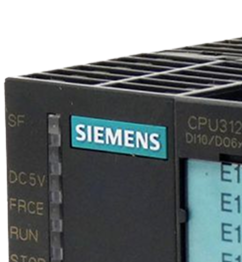
The Siemens SIMATIC S7-300 has been one of the most widely deployed PLC families in modern industry. For over two decades, it has offered manufacturers flexibility and reliability. Its modular design makes it suitable for a wide range of applications, from small tasks to complex, plant-wide systems [1].
With Siemens confirming a P.M410 type discontinuation of the S7-300 in October 2025[2], engineers and procurement teams face important decisions. The end of production does not imply that systems will fail immediately. However, it does signal the onset of supply limitations, rising costs, and diminished support. Planning early will allow organisations to minimise risk, avoid unplanned downtime and prepare for a stable migration.
What was the S7-300?
Its role in factories worldwide
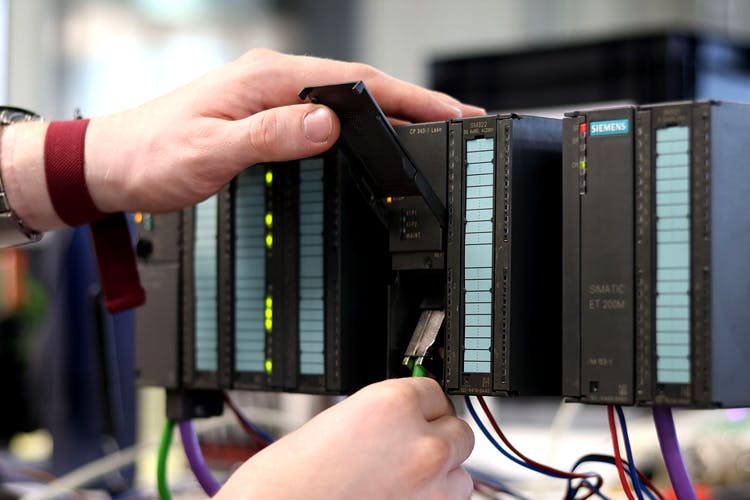
The S7-300 played a central role in the growth of automated production. They installed it in diverse sectors including automotive, pharmaceuticals, food and beverage, and packaging [1]. The controller’s modularity meant it could be expanded with CPUs, I/O modules and communication processors to meet different requirements.
Why it became so widely used?
Several features supported the S7-300’s success. It provided stable operation over long service lifespans, which gave manufacturers confidence in its reliability [3]. The STEP 7 software environment made programming accessible, reducing barriers for engineers adopting Siemens systems.
The wide ecosystem of compatible modules and add-ons meant businesses could configure the controller to suit specific needs. Over time, the S7-300 became one of Siemens’ most successful automation products. It has been installed in factories around the globe [3].
Key phase-out information
Official discontinuation dates
Siemens has formally announced that the SIMATIC S7-300 will be a P.M410 type discontinuation on 1st October 2025 [2].
Spare parts availability
Siemens will continue to offer spare parts and repair services for several years following the discontinuation. However, the supply will gradually decrease over time [2]. Lead times are expected to increase as demand outpaces stock. The secondary market may offer modules for longer, but costs are already rising [4].
What Siemens support looks like after 2025
Siemens’ lifecycle support will shift focus to its newer platforms, particularly the S7-1500 and S7-1200 families [2]. Technical documentation and resources for the S7-300 will remain available but will receive fewer updates.
Risks of waiting too long
1. Spare part costs
Experience with other discontinued PLC families shows that costs rise sharply once official production stops [4].
2. Risk of downtime
Unplanned downtime remains the most critical risk. A single failed CPU or I/O module without a replacement can halt entire production lines.
3. High production losses
In high-volume manufacturing, downtime can be quite costly. Even just one hour can lead to tens of thousands of pounds in lost output. [4].
4. Security and compliance issues
The S7-300 was designed in an era with fewer digital threats and does not include the advanced protections now expected [2].
Upgrade paths beyond the S7-300
S7-1500 (main successor)
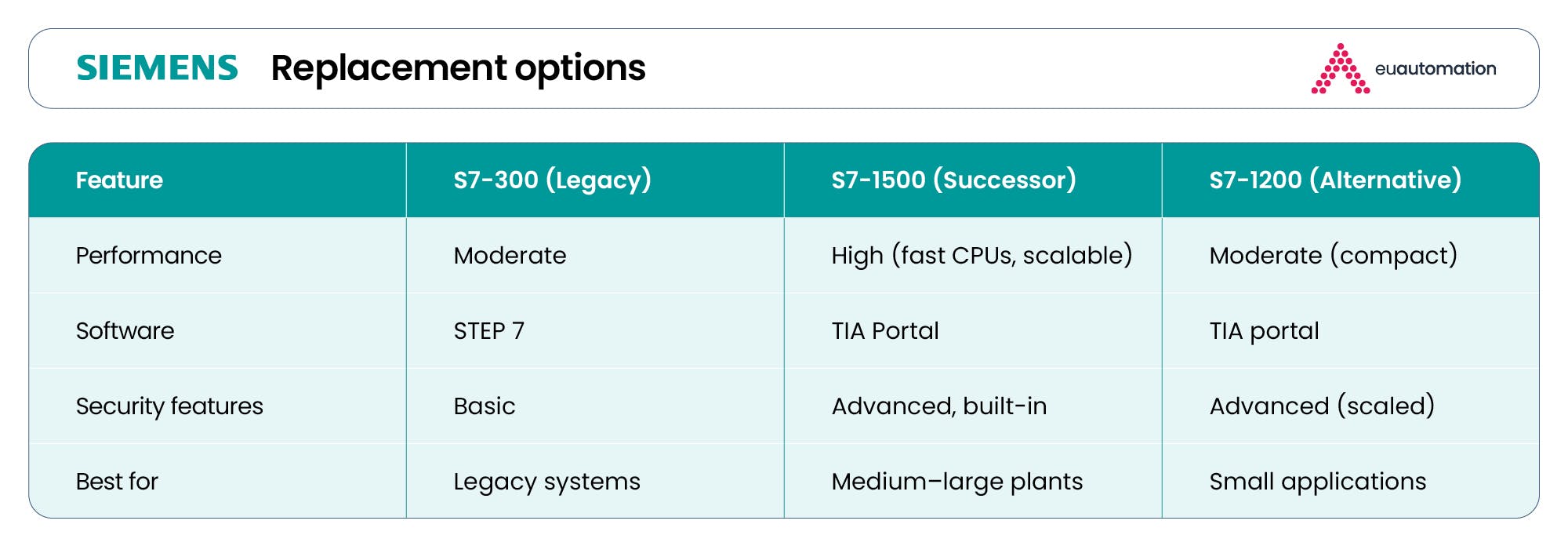
The SIMATIC S7-1500 is Siemens’ flagship controller and the natural successor to the S7-300. It delivers faster cycle times, integrated diagnostics and enhanced cybersecurity features [2].
S7-1200 (for smaller setups)
For compact installations or lower-complexity applications, the SIMATIC S7-1200 is a cost-effective option [2].
ET 200 series for I/O upgrades
The ET 200MP and ET 200SP families are designed to replace the ET 200M modules associated with the S7-300 [4].
Migration made simple
Hardware upgrades
Hardware migration involves replacing CPUs and associated modules. Siemens provides detailed migration guides to support engineers in planning these changes [2].
Software transition (STEP 7 → TIA Portal)
Transitioning from STEP 7 to the TIA Portal engineering framework brings several benefits. It consolidates engineering tasks, enhances diagnostics, and simplifies the process of system expansion [2].
Tools Siemens offers to help
Siemens supports migration with compatibility charts, software wizards and structured training programmes [2].
What procurement teams should do now
Check stock levels
Audit current inventories of S7-300 modules and spare parts. Identifying shortfalls early helps procurement teams avoid last-minute purchases at inflated costs [4].
Budget and plan early
Phased budgeting spreads investment across several years, reducing financial pressure and ensuring smoother implementation [2].
For Siemens lifecycle planning, see: The Challenge of Siemens Product Lifecycle.
Example: managing obsolescence in practice
For example, a large food manufacturer would face S7-300 obsolescence across multiple production lines. By securing a limited stock of spare parts, the company can begin a phased migration to the S7-1500. This approach will help reduce downtime risk while modernising operations [4].
Conclusion
The P.M410 discontinuation of the Siemens SIMATIC S7-300 in October 2025 represents a turning point in industrial automation [2]. The controller has provided decades of reliable service. However, businesses that continue to rely on it beyond its lifecycle may face rising costs, security risks, and operational instability.
Early preparation through stock audits, budgeting and migration planning reduces exposure. Migration to the S7-1500 or S7-1200 ensures long-term support, improved performance and greater resilience.
FAQs
1. When will Siemens S7-300 be discontinued?
The Siemens SIMATIC S7-300 will reach its official end of production in October 2025 [2].
2. What replaces the Siemens S7-300?
Siemens recommends migrating to the S7-1500 for medium to large applications, or the S7-1200 for smaller systems. The ET 200MP and ET 200SP series replace the ET 200M modules [4].
3. How long will Siemens support the S7-300?
Spare parts and repairs will be available for several years after 2025. However, their availability will decrease as Siemens focusses on newer platforms [2].
References
- https://www.siemens.com/global/en/products/automation/systems/industrial/plc/simatic-s7-300.html
- https://support.industry.siemens.com/cs/document/109809890/information-about-the-product-phase-out-of-s7-300-et-200m-components?dti=0&lc=en-US
- https://www.artisantg.com/info/Siemens_S7_300_Manual.pdf
- https://support.industry.siemens.com/cs/document/109748461/industrial-communication-profinet-profibus-nutzerorganisation-e-v-(pno)?dti=0&lc=en-GB