The complete guide to industrial maintenance strategies
Why maintenance strategy matters now
Unplanned downtime is one of the highest controllable costs in modern manufacturing. A 2024 Siemens report estimated that unplanned downtime costs the Global Fortune 500 companies $1.4 trillion annually [1]. Plant managers require structured maintenance strategies to keep lines running predictably and profitably.
Reliance on fixing broken equipment is unsustainable. Poor maintenance practices can reduce a plant's overall productive capacity by up to 20% [2].
Regulation is another factor. Safety legislation and environmental law continue to raise the bar on equipment reliability. There are environmental and safety risks with unreliable infrastructure.
Regular maintenance helps with compliance by keeping staff safe and limiting exposure to fines by regulators like the HSE or the Environment Agency.
Digital systems now provide continuous asset data that was previously unavailable. Sensors and analytics software allow teams to monitor conditions in real time. The availability of data is changing maintenance from reactive intervention to planned action.
Selecting the appropriate approach requires assessing the asset, how it fails and the plant's operational maturity.
The four main industrial maintenance strategies at a glance
The four main strategies are reactive, preventive, predictive and condition-based maintenance. The industry often promotes one approach over the others.
"In practice, most successful plants run a combination of strategies. A reliability engineer must understand how each asset fails before deciding which strategy applies.
The objective is to find the right balance of cost, risk and performance. The ISO 55000 asset management framework provides the structure for this decision.
What is reactive maintenance?
This approach involves running equipment until it fails. Technicians repair or replace components only after a breakdown. It requires no upfront planning but carries high risk for critical assets and produces unpredictable maintenance budgets.
What is preventive maintenance?
This strategy schedules regular interventions based on time or usage cycles. Technicians replace parts before they reach their expected failure point. It extends equipment life but can lead to replacing components with remaining useful life.
What is predictive maintenance?
This method uses sensor data and analytics to forecast when a failure will occur. Interventions happen only when needed and the strategy demands significant upfront investment in technology and analytical skills.
What is condition-based monitoring?
This involves tracking specific asset parameters such as vibration or temperature. An alert triggers maintenance when a parameter crosses a predefined threshold. It serves as the foundation for any predictive programme.
Reactive maintenance
Reactive maintenance involves waiting for a machine to fail before taking action. Technicians act only in response to unplanned stoppages, with no proactive interventions or routine inspections.
Run-to-failure is often the result of having no strategy at all. It has a legitimate use when applied deliberately to assets where intervention is not justified. Plants apply it to equipment with low replacement cost and no impact on overall production.
When failure carries no safety, environmental or production consequence, planned service can cost more than allowing failure and replacement. The method becomes a liability only when applied to critical machines.
When is reactive maintenance used deliberately?
In an advanced reliability programme, reactive maintenance is applied selectively. It is not the result of oversight. It fits assets where failure has low risk, or where preventive work costs more than it delivers.
Common examples:
- Office area lighting and similar low-risk equipment
- Standard workshop equipment with spare capacity
- Inexpensive small equipment with low usage frequency
- Equipment where failure carries no safety, environmental or production risk
The benefits are simplicity and minimal upfront investment. The downside is the complete loss of control over downtime timing.
The financial impact of unplanned failure
The direct cost of critical asset failure includes emergency parts and premium overtime rates. The indirect costs are typically higher, covering lost production time, missed delivery deadlines and idle staff.
Examples of the cost of unplanned failure:
- Emergency procurement - critical parts ordered urgently can cost significantly more than scheduled orders
- Overtime labour - repair technicians on overtime cost more per hour and increase the risk of fatigue-related errors
- Secondary damage - catastrophic component failure typically damages surrounding equipment
- Logistics disruption - breakdowns trigger expedited shipping costs and knock-on effects through the supply chain
The National Institute of Standards and Technology (NIST) reports that manufacturing plants relying heavily on reactive maintenance experience 3.3 times more downtime and 16 times more defects than those using proactive strategies [3].
Preventive maintenance
In preventive maintenance, intervention intervals are fixed in advance. They are typically based on calendar time or operating cycles, often derived from OEM baseline recommendations and refined against the plant's own historical mean time between failures (MTBF).
The goal is to intervene before component wear progresses to failure. Lubricating a process pump bearing every 500 hours, for example, is a preventive task performed regardless of component condition.
Fixed schedules improve production predictability and reduce the risk of secondary damage to connected assets. Preventive maintenance is the foundational approach in most plants and provides a baseline of planned care.
Scheduling logic and execution
A preventive programme depends on reliable historical failure data. Engineers use MTBF as the starting point, then apply a safety margin to set the replacement interval.
If a bearing typically fails at 12 months under continuous operation, the schedule might trigger replacement at month 10. These schedules are managed through a computerised maintenance management system (CMMS).
Strengths of a preventive approach
The primary strength is predictability. Scheduled interventions allow plant managers to plan downtime around low-demand periods and pre-source labour and spares. The approach also maintains equipment condition and supports compliance with safety regulations such as PUWER [4].
Weaknesses and limitations
The primary weakness is excessive maintenance. Technicians can prematurely replace parts with remaining useful life, wasting spares and labour. Opening a correctly-functioning machine also introduces infant-mortality failures through human error or contamination.
Each manual intervention creates an opportunity for incorrect reassembly, improper fastener torque or contamination during routine oil changes. These can cause failures that would not otherwise occur.
Typical industries applying this method
Process industries with stringent compliance requirements depend on preventive schedules. Food and beverage plants use it to maintain hygiene standards and meet HACCP requirements. Pharmaceutical manufacturers rely on time-based servicing to ensure batch consistency and support regulatory compliance.
Predictive maintenance
Predictive maintenance uses real-time data to identify when intervention is genuinely required, rather than at fixed intervals or after failure. It draws on live sensor streams and statistical analysis to determine optimal timing.
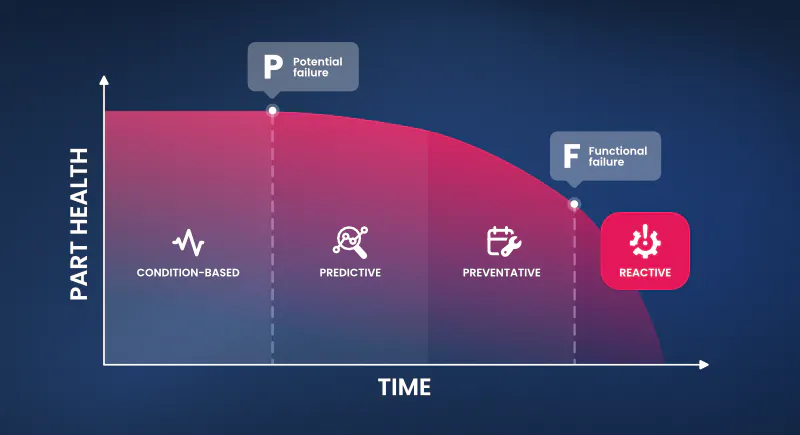
Teams aim to act after a potential failure is detected but before functional failure occurs.
This proactive window allows the team to extract maximum useful life from each component while preventing unplanned outage. It is the most data-intensive of the four strategies.
The strategy requires connected sensors that record asset data and software that analyses incoming streams. Algorithms identify failure signatures from live data flows.
Understanding the P-F curve
The P-F curve shows what is happening inside a machine in the run-up to failure. Every predictive programme is built around it because it identifies the warning period available to the maintenance team.
Point P is the potential failure point, where the first detectable signs of degradation appear. Point F is the functional failure point at which the asset stops working entirely.
The interval between P and F provides the window for action. Predictive techniques aim to identify Point P as early as possible to increase the time available to the plant.
A wider window gives procurement time to source parts and production planners time to schedule downtime around demand.
What does this strategy require?
The plant needs sensors, a reliable industrial network and analytical software. Sensors capture high-frequency data, the network transmits it securely and the software interprets it. In more advanced systems, machine learning identifies complex failure patterns that human analysts find difficult to detect.
Where this approach delivers value
This strategy suits critical, expensive machinery where downtime is unacceptable. Large turbines, primary compressors and main production line drives justify the investment.
Initial setup costs are high. Plants must also develop or hire the analytical capability to interpret condition data.
The benefit is lead time. A planning window of days to weeks allows teams to consolidate maintenance activities and source parts at competitive prices.
This window only delivers value if the necessary parts can be sourced within the timeframe. EU Automation provides a catalogue of current and discontinued components designed to meet these specific procurement windows.
Financial data support the adoption of these models:
- Siemens research indicates that digital twin deployments can reduce reactive maintenance time by around 25% and overall downtime by 20% [5].
- According to McKinsey & Company, predictive maintenance reduces equipment downtime by 30% to 50% [6].
- A PwC survey found that 95% of IoT-based predictive maintenance users reported improvements in uptime, cost savings and asset lifetime [7].
Condition-based monitoring
Condition-based monitoring measures specific aspects of equipment health at regular intervals or on a prescribed route. It tracks deviations from normal operating parameters and uses defined alert thresholds.
Reliability engineers establish baseline values for each monitored parameter under normal operating conditions. When a sensor reading exceeds an acceptable threshold, the platform issues an alert. A bearing may operate safely at 40 degrees Celsius, for example.
When the bearing surface exceeds 60 degrees Celsius, the monitoring software issues a warning and prompts maintenance planners to schedule a repair before failure.
Replacement is triggered by evidence of active degradation rather than by a fixed interval. This reduces spare parts waste and lowers total maintenance cost.
Relationship to predictive strategies
Condition monitoring is the physical act of gathering data. When a vibration sensor detects an anomaly and triggers an alarm, that is condition monitoring.
When software uses that history to forecast when the motor is likely to fail, that is predictive maintenance. Condition monitoring is the prerequisite and foundation for any predictive capability.

Typical parameters monitored
Monitoring takes different forms depending on the asset type. The most common methods include:
- Vibration - identifies imbalance, misalignment and bearing wear in rotating equipment
- Thermography - finds electrical hot spots, mechanical friction and insulation failures using IR cameras
- Oil analysis - identifies wear particles, contamination and chemical degradation of lubricants
- Ultrasonic - detects early-stage bearing faults, compressed air leaks and electrical arcing
Correct sensor selection produces reliable data. The wrong sensor produces false alarms or missed faults.
How the strategies work together in practice
A facility that combines strategies can deliver the lowest total cost. This is the balanced approach at the core of reliability-centred maintenance.
Asset criticality drives selection
Reliability engineers classify equipment by its importance to the business. Classification considers safety risk, production impact and repair cost. A main feed pump might rank as highly critical. A secondary extraction fan might rank as low criticality. The resulting ranking determines the maintenance approach for each asset.
A practical hybrid example
Consider a large paper mill. The main paper machine drive runs on continuous predictive maintenance, since failure stops the entire factory. The hydraulic power units use condition-based monitoring with monthly oil checks.
The conveyor belts feeding raw materials run on a preventive schedule based on tonnage. Warehouse lighting operates on reactive maintenance.
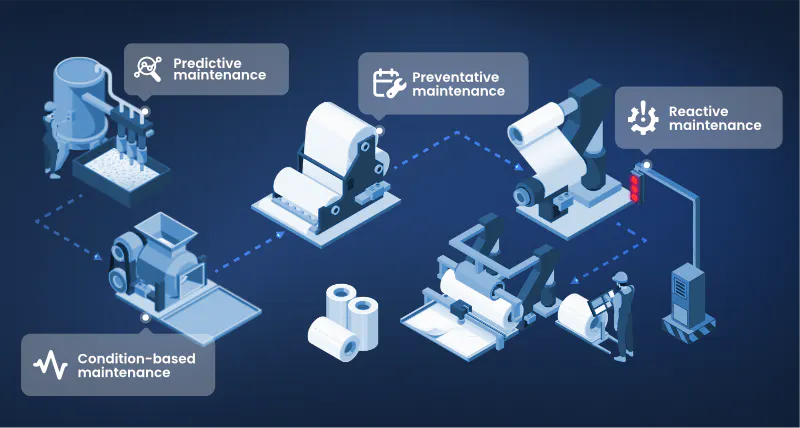
Disclaimer: This diagram is for illustrative purposes only and presents one hypothetical example of how maintenance strategies may be applied. It should not be interpreted as a recommendation or prescriptive guidance for any specific facility or maintenance programme.
Metrics for measuring success
Plant managers evaluate the success of a hybrid strategy through maintenance KPIs. MTBF measures reliability. Mean time to repair (MTTR) measures how long repairs take once started. Overall equipment effectiveness (OEE) measures availability, performance and quality.
A well-balanced strategy produces measurable improvement across these metrics over time. Total productive maintenance (TPM) principles reinforce the gains by giving operators a share of the responsibility for improvement.
Choosing the right strategy
Selection requires a structured decision framework. Managers cannot default to the newest technology. They must assess what the plant can realistically support.
Decision framework criteria
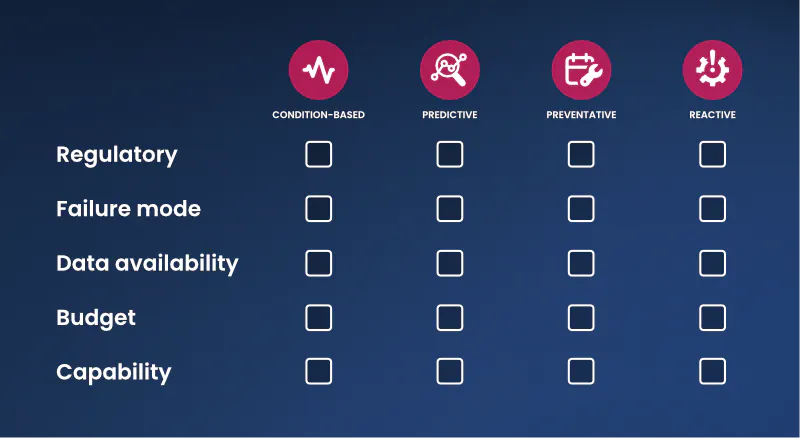
Reliability teams evaluate assets against five primary criteria:
- Failure modes - how does the machine break? Random failures suit predictive monitoring. Age-related failures suit preventive schedules
- Data availability - does the machine already have internal sensors? Older legacy equipment may require costly retrofits to enable data collection
- Budget constraints - predictive systems demand high initial capital expenditure, while preventive schedules require sustained ongoing labour budgets
- Technical capability - does the site employ technicians capable of vibration analysis or thermography? If not, the plant must develop in-house capability or use contractors
Regulatory requirements - some assets have inspection or maintenance intervals set by safety legislation. These override strategy choice and must be factored in first
Maintenance strategy checklist
Balancing reliability-centred maintenance (RCM) and budget
The cheapest control is not always the worst one. Reliability-centred maintenance gives teams a logical process for matching the strategy to the specific failure mode.
A simple weekly inspection sometimes offers a better return than an expensive continuous sensor.
Total productive maintenance (TPM) and OEE
Where RCM addresses the what, TPM addresses the operational how. TPM puts day-to-day reliability in the hands of operators.
One of the central goals of the system is Overall Equipment Effectiveness, or OEE. This is calculated by multiplying availability, performance and quality.
Autonomous maintenance is a crucial part of TPM. It enables operators to handle routine basic care, including cleaning, lubrication and simple inspections.
This catches a significant share of issues during normal operations and reduces the load on the maintenance team.
Spare parts strategy and maintenance approach
A maintenance strategy is only as effective as the procurement chain that supports it. A predictive system may correctly identify a fault, but if the required part has a six-week lead time the result is an avoidable outage.
Procurement reliability often depends on sourcing components that original manufacturers no longer support. Specialist suppliers such as EU Automation stock a long tail of obsolete and hard-to-find parts to ensure a predictive alert results in a planned repair rather than an unplanned outage.
Interplay between approaches
A facility relying on a reactive approach must carry an extensive inventory. With no advance warning of failures, it must hold more spares than a proactive plant. This ties up working capital.
A preventive approach allows for leaner inventory. Procurement teams know which parts will be needed and when, and can order them to arrive just before scheduled service.
Predictive programmes offer the leanest inventory model. Weeks or months of warning let procurement source parts at competitive prices and avoid emergency-delivery premiums.
Common pitfalls in strategy selection
The move between strategies often fails because of predictable errors. Many plants invest heavily in software but ignore foundational practices. Recognising the pitfalls prevents wasted investment.
- Automating for its own sake - adding sensors to every asset creates data fatigue and overwhelms the reliability team. Sensors must produce a quantifiable benefit
- Neglecting staff training - moving to TPM or predictive maintenance requires a culture change. Without employee buy-in and proper training, new technologies are bypassed or ignored
- Over-reliance on historical failure data - traditional predictive models require extensive historical data, which can delay deployment by years. Anomaly-detection approaches can identify deviations from normal operation without that history
- Inadequate documentation - Standard Operating Procedures (SOPs) are the foundation of any strategy. Without them, tasks drift out of alignment and maintenance becomes inconsistent
- Failing to plan for obsolescence - selecting technologies without considering long-term scalability or vendor support can leave a plant dependent on rare expertise or unobtainable spare parts
Deployment roadmap
Moving from a reactive baseline to a proactive culture requires measured steps. A solid foundation must precede any move to advanced predictive models.
The following sequence outlines a typical upgrade path:
- Audit existing assets to establish an equipment register
- Complete a criticality assessment to rank assets from highest risk to lowest
- Define standard preventive maintenance plans for all critical and semi-critical equipment
- Install or upgrade a CMMS to record all work orders and spares
- Introduce condition-based monitoring on the most critical assets, typically the top 10-20%
- Develop in-house capability to interpret condition monitoring data
- Integrate condition data with the CMMS so alerts automatically generate or inform work orders
- Expand monitoring to include predictive analytics on the most important machinery
- Review and adjust preventive schedules, removing redundant tasks now covered by sensors
- Continuously measure maintenance KPIs to refine the strategy mix over time
Conclusion
Maintenance strategy is the structured allocation of approaches across a plant's assets. The right combination depends on asset criticality, failure modes, data infrastructure and regulatory context.
Frameworks such as RCM and TPM provide the structure for these decisions and an effective spare parts strategy makes them executable.
The priority for most plants is aligning the selection with operational reality. Data, budget and capability constraints carry as much weight as the strategy itself.
Plants that achieve sustained reliability improvement treat maintenance strategy as an ongoing discipline.
References
[3] https://nvlpubs.nist.gov/nistpubs/ams/NIST.AMS.100-34.pdf
[4] https://www.hse.gov.uk/work-equipment-machinery/puwer.htm
[5] https://press.siemens.com/global/en/pressrelease/siemens-introduces-ai-agents-industrial-automation
[7] https://www.pwc.nl/nl/assets/documents/pwc-predictive-maintenance-beyond-the-hype-40.pdf