How to find obsolete automation parts without risking downtime
Obsolete automation components are becoming an increasingly common challenge across manufacturing. While many production facilities continue to rely on equipment that remains operational for decades, the components within those systems often have significantly shorter product lifecycles.
Manufacturers regularly retire older product lines as technology advances, support requirements change and newer platforms are introduced. As a result, organisations may find themselves operating critical equipment that depends on components no longer in production.
When a failure occurs, sourcing a replacement can become a time-sensitive task. Limited inventory availability, compatibility concerns and longer lead times can all affect production continuity. Understanding the factors that influence obsolete component sourcing is therefore becoming an important part of asset lifecycle management.
Why do automation components become obsolete?
Product discontinuation is often driven by technological change. As automation platforms evolve, manufacturers introduce new products that offer enhanced functionality, improved connectivity and stronger cybersecurity features.
Supply chain factors can also influence lifecycle decisions. Electronic components, processors and materials may become difficult to source, making continued production commercially impractical.
Regulatory requirements present another consideration. Changes to environmental standards, safety requirements and cybersecurity expectations can encourage manufacturers to replace older platforms with products that better support current industry requirements.
For end users, the result is often the same. Equipment may remain operational long after replacement components become difficult to obtain.
The real cost of obsolescence
The effects of obsolete automation components often extend beyond the cost of a replacement part. Modern production environments rely on interconnected equipment, meaning a single component failure can disrupt multiple processes.
Unplanned downtime remains one of the most significant challenges associated with ageing automation systems. Research highlighted by the Association of Electrical and Mechanical Trades (AEMT) suggests downtime can account for around 11% of annual revenue for large manufacturers[1]. The Institute for Supply Management also highlights unscheduled downtime as a key operational metric for manufacturers, reinforcing the wider business impact of production disruption [2].
Obsolescence also affects purchasing decisions. As components become harder to source, manufacturers may encounter reduced stock availability, longer lead times and higher prices. When sourcing activity begins after a failure has occurred, the number of available options is often reduced.
Cybersecurity is another consideration. Unsupported automation hardware may no longer receive updates or security patches. This can create additional challenges for organisations operating within regulated environments. Standards such as IEC 62443 provide guidance on securing industrial automation systems and managing risks linked to legacy equipment [3]. The NIST Cybersecurity Framework and CISA’s industrial control systems resources also provide guidance for managing cybersecurity risk across operational technology environments [6][7].
Common challenges when sourcing obsolete components
Finding obsolete automation parts involves more than locating available stock. Product identification, compatibility checks and supplier assessment can all influence the outcome of a sourcing project.
Component identification remains a common challenge. While a part number may appear correct, differences in revision levels can affect compatibility. Communication modules, processors and other critical devices often exist in multiple hardware versions, making detailed verification an important step.
Manufacturers must also assess whether successor products are suitable replacements. Newer models may offer similar functionality but differ in firmware requirements, software dependencies or communication protocols. These factors can affect installation and ongoing operation.
Timing can further complicate sourcing activity. As inventories decline, replacement options become more limited. This is particularly relevant for products that have been obsolete for several years.
Supplier selection also plays an important role. Product traceability, testing procedures and warranty coverage can all influence the long-term suitability of a replacement component.
Identifying the correct replacement component
Accurate identification is often one of the most important stages in the sourcing process. Small differences between products can have significant implications for compatibility and performance.
Part numbers should be reviewed carefully, including any suffixes, revision identifiers and firmware requirements. Maintenance records, equipment documentation and asset registers can all help confirm the correct specification.
Where direct replacements are unavailable, organisations may need to evaluate alternative versions or successor products. Understanding how these alternatives interact with existing systems can help reduce implementation risks and avoid additional downtime.

Evaluating available sourcing routes
Manufacturers generally have several options when searching for obsolete automation parts. The most suitable route depends on operational priorities, component availability and lead-time requirements.
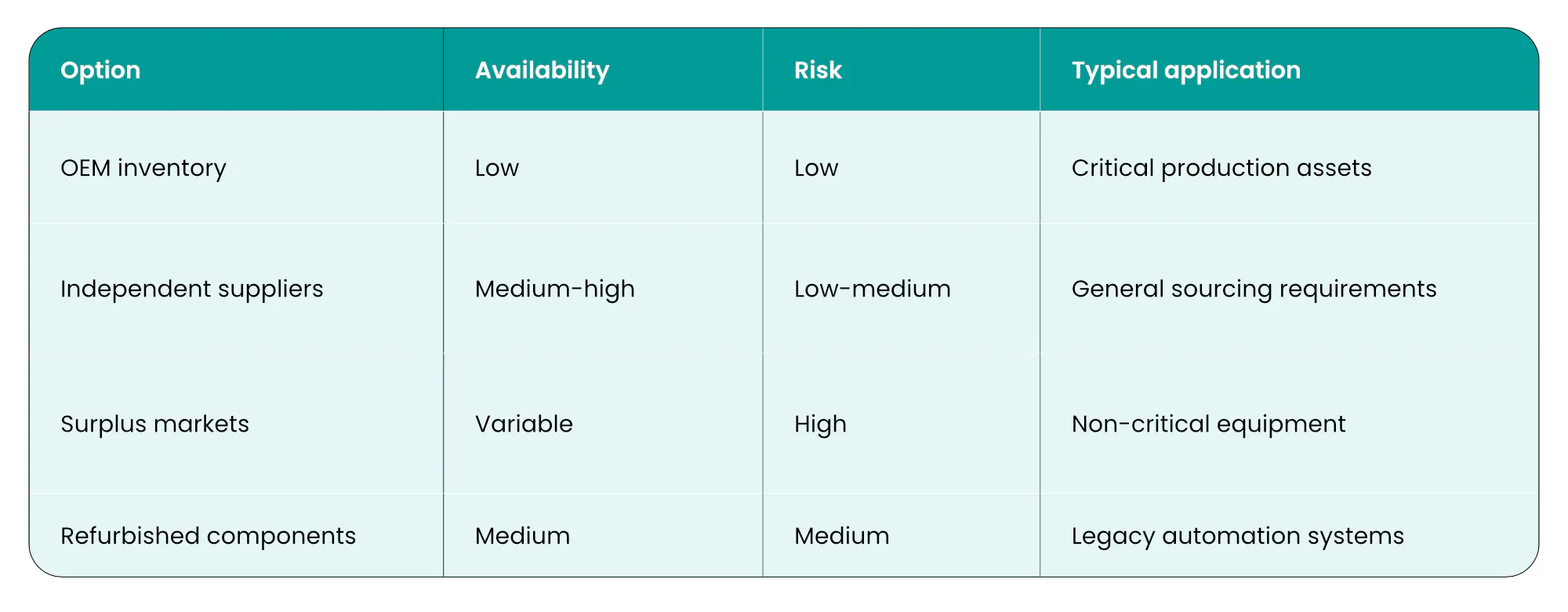
Original equipment manufacturer inventory often provides the highest level of assurance. Availability can become limited once a product reaches end-of-life, leading many organisations to explore specialist suppliers with access to wider inventory networks.
Global sourcing networks can provide access to stock that is no longer available within a particular region. This broader market visibility can help manufacturers maintain equipment and reduce disruption.
Availability alone should not determine purchasing decisions. Product condition, testing standards and traceability records all contribute to long-term reliability and should be considered alongside lead time and cost.
Compatibility and installation considerations
Even when a suitable replacement component has been sourced, compatibility remains an important consideration. Hardware, firmware and software dependencies can all affect integration within existing systems.
Communication protocols, network requirements and application-specific configurations may also influence performance. These factors become particularly relevant when successor products or alternative versions are introduced into established environments.
Testing replacement components before deployment can help identify potential issues and reduce operational disruption. This approach is particularly valuable for equipment supporting critical production processes.
What if the part is no longer available?
In some situations, a direct replacement may no longer be available. Organisations then need to consider alternative approaches for maintaining equipment availability.
Repair services may provide one option, particularly where specialist expertise exists for legacy systems. Refurbished components can also help extend the life of existing equipment when new inventory is unavailable.
Where obsolescence affects multiple components within a system, retrofit projects may become a practical alternative. Replacing selected elements of an automation platform can help improve supportability while limiting the scope of wider system changes.
For some facilities, a broader upgrade strategy may ultimately provide greater long-term value. This decision often depends on factors such as equipment age, spare part availability, maintenance costs, future operational requirements and budget availability.
Planning for long-term obsolescence
Many manufacturers are adopting broader approaches to obsolescence management. These approaches focus on identifying risks earlier and reducing reliance on emergency sourcing activity.
Accurate asset records, lifecycle monitoring and spare parts planning can improve visibility across installed equipment. This information supports more informed decisions around sourcing, repair and system upgrades.
Long-term planning can also contribute to wider operational objectives. Predictable maintenance costs, improved cybersecurity and greater resilience are all factors that influence asset lifecycle decisions.
As automation systems continue to change, obsolescence management is becoming an increasingly important aspect of maintaining production continuity.
Conclusion
Obsolete automation components present a growing challenge for manufacturers operating long-life production equipment. While sourcing replacement parts remains an important consideration, the wider implications often extend to operational resilience, maintenance planning and asset lifecycle management.
Successful sourcing strategies depend on more than inventory availability alone. Product identification, compatibility verification, authenticity checks and supplier assessment all contribute to reducing operational risk and maintaining equipment performance.
As automation platforms continue to evolve, organisations that take a proactive approach to obsolescence management will be better positioned to maintain production continuity and respond effectively to future lifecycle changes.
For manufacturers operating ageing automation systems, access to reliable sourcing expertise can play an important role in managing these challenges. With a global network of suppliers, access to hard-to-find automation components and experience supporting legacy equipment across a wide range of industries, EU Automation helps manufacturers maintain production continuity when critical parts become difficult to source.
References
[1] https://www.theaemt.com/resource/the-true-cost-of-downtime-2024-a-comprehensive-analysis.html
[3] https://www.isa.org/standards-and-publications/isa-standards/isa-iec-62443-series-of-standards