The complete guide to sourcing and managing automation components in a disrupted supply chain
Sourcing has become one of the hardest jobs in industrial operations, and sound sourcing strategies are now a core part of keeping a plant running. Global supply chain disruptions rose 38% in 2024 compared with the year before, according to monitoring data from Resilinc, with general manufacturing and high tech among the five most affected industries [1]. For a plant that runs on specialised automation parts, every one of those events is a potential gap between a component failing and its replacement arriving.
The exposure is structural, not occasional. McKinsey estimates that disruptions lasting a month or longer now strike global supply chains every 3.7 years on average, and that a single severe shock can wipe out close to half of one year’s profit in the affected business [2]. A sound sourcing strategy is what stands between a plant and that kind of loss. It decides whether a failed part is a quick swap or a line down for weeks.
This guide sets out how industrial teams can build a sourcing strategy that holds up when the supply chain does not. It covers the risks specific to automation components, how to manage lead times, how to source hard-to-find and obsolete parts and how to fold all of this into a wider asset management plan.
What sourcing strategies mean for industrial automation
A sourcing strategy is the plan that governs where components come from, how many suppliers are used, how lead times are managed and what happens when a part is no longer available. For industrial automation, it is narrower and more technical than the generic supply chain advice written for retail or consumer goods. The parts are specialised, the volumes are low and a single discontinued module can halt a production line.
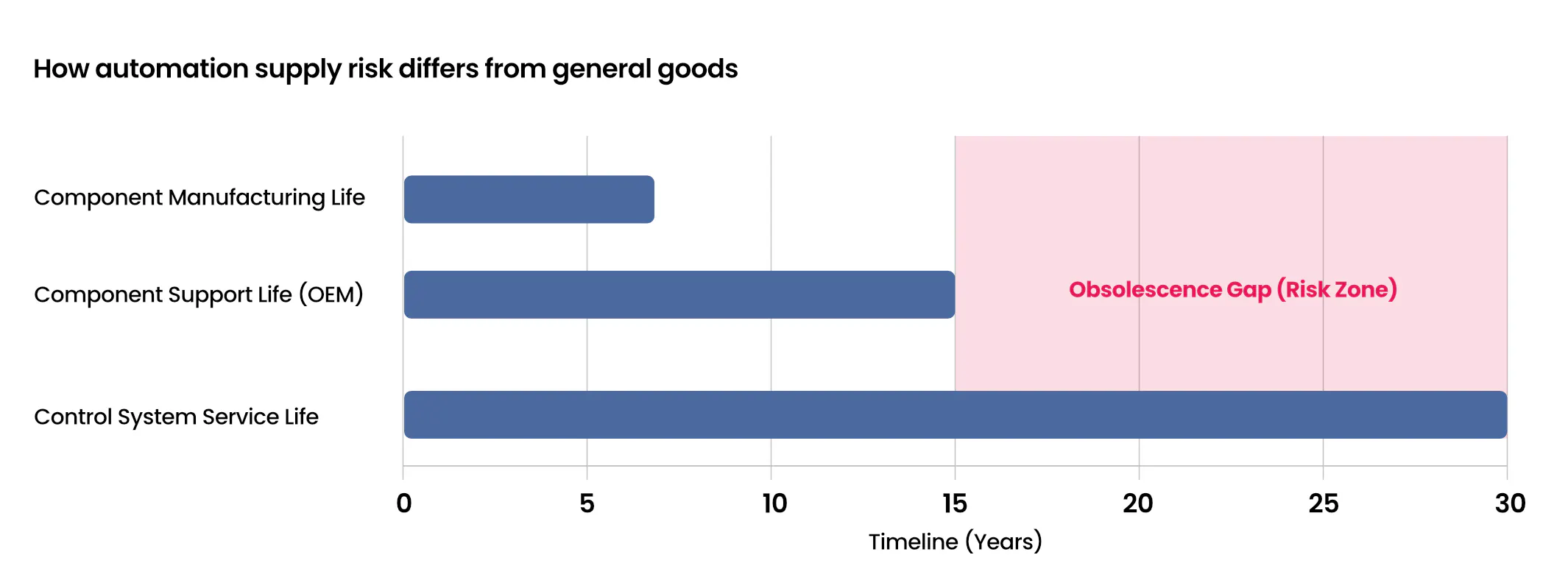
Most published guidance on supply chain strategy targets fast-moving consumer products, where the priority is forecasting demand and moving finished goods to customers. Industrial automation has the opposite problem. Demand for a specific spare is low and irregular, the part may have a fifteen-year service life, and the original manufacturer may have stopped making it years ago. A sourcing strategy for a plant has to plan for scarcity, not volume.
Three questions sit at the centre of any industrial sourcing strategy:
- Availability - can the part be obtained at all, including obsolete and hard-to-find components no longer carried by the original manufacturer?
- Lead time - how long will it take to arrive, and can the plant survive that gap with the spares it holds?
- Risk concentration - how many suppliers and how many regions does the plant depend on for its critical components?
Get those three right and most sourcing decisions follow. The sections below take each in turn.
Why automation supply chains break differently
Industrial automation supply chains fail for reasons that rarely affect consumer goods. The components are built in smaller runs, depend on constrained semiconductor supply and stay in service long after they leave the catalogue. A disruption that a retailer absorbs in a week can keep a plant down for a month.
Lead times are the first pressure point. During the recent semiconductor shortage, average chip delivery times reached 20.2 weeks, the longest since tracking began in 2017 [3]. Programmable controllers and drives that depend on those chips inherited the delay. A part that once shipped in days stretched to several months, and plants that held no buffer stock simply waited.
Concentration is the second. McKinsey’s 2024 survey of supply chain leaders found that only 60% of companies had full visibility of even their tier-one suppliers [4]. Many plants discover a single point of failure only when it fails, when a sole supplier in a single region cannot deliver and there is no qualified alternative on file. The same research found it takes companies an average of two weeks just to plan and execute a response to a disruption [4].
Obsolescence is the third and the most particular aspect of automation. Industrial assets run for decades, but the electronics inside them are retired on a consumer timescale. A controller installed in 2010 may still be running a critical process while its manufacturer declared it end-of-life years ago. When it fails, there is no new stock to buy, and the plant is left sourcing from the secondary market or facing an unplanned upgrade.
How automation supply risk differs from general goods
Typical service life: consumer goods - months to a few years; industrial automation components - decades.
Demand pattern: consumer goods - high volume, relatively steady; industrial automation components - irregular, low volume.
Lead-time sensitivity: consumer goods - moderate; industrial automation components - high.
Obsolescence exposure: consumer goods - moderate; industrial automation components - high.
Cost of a stockout: consumer goods - lost sale or delay; industrial automation components - very high (line stoppage, safety and regulatory impact). These three risks compound. A long lead time on an obsolete part sourced from a single supplier is the worst case, and it is more common than most plants assume.
How can plants reduce lead-time risk?
Lead-time risk is the gap between when a part fails and when its replacement arrives. The aim is to shorten that gap, or to bridge it with stock, before a failure forces the issue. Plants that manage lead times well treat them as data to be tracked, not a fixed property of a supplier.
A practical lead-time programme follows a clear sequence:
- Map the lead time for every critical component, using real order history rather than the supplier’s quoted figure.
- Identify the parts where the lead time is longer than the plant can survive on existing spares.
- Qualify a second source for those parts, so a single supplier delay does not become a line stoppage.
- Hold buffer stock for the components with the longest lead times and the highest criticality.
- Track actual delivery performance over time and adjust the buffer as lead times move.
The first step is the one most often skipped. Quoted lead times and real lead times diverge sharply under stress, and a plan built on the catalogue figure breaks the moment the supply chain tightens. Order history tells the truth.
Buffer stock carries a cost, which is why step four is selective rather than universal. Holding inventory ties up capital and storage, and carrying costs typically run at 20% to 30% of the inventory value each year [5]. The point is not to stock everything. It is to stock the few parts whose absence would be most expensive, a judgement covered in the guide to Strategic spare parts planning: how many is enough and why.
Sourcing hard-to-find and obsolete parts
Obsolescence is the defining sourcing problem in industrial automation. The standard that governs it, IEC 62402, defines obsolescence as the change of a required item from available to unavailable from its manufacturer [6]. For a plant, that change is rarely announced in advance and is usually discovered at the worst moment, when a part fails and there is no new stock to order.
A part going end-of-life does not mean the asset has to be replaced. A controller, drive or I/O module can keep a line running for years after the manufacturer stops making it, provided a replacement can be found when it fails. The question is no longer whether the part is in the current catalogue. It is whether a working unit can be sourced at all.
There are three routes to an obsolete component, each with trade-offs:
- Sourcing the original part from specialist stock - fastest where available, keeps the existing system unchanged, depends on the part being held somewhere.
- Repair or refurbishment of the failed unit - viable for some assemblies, slower and not always possible once a component inside has itself gone obsolete.
- Upgrading to a current equivalent - removes the obsolescence problem but carries engineering cost, downtime and revalidation, so it suits a planned change rather than an emergency.
For the first route, EU Automation holds a catalogue of current, hard-to-find and obsolete industrial automation components, including parts that the original manufacturers no longer support. Sourcing an obsolete unit fast is often the difference between a few hours of downtime and an unplanned upgrade project, and it lets a plant choose to modernise on its own schedule rather than under failure pressure. The deeper mechanics of spotting obsolescence risk early and building a managed approach are covered in How to find obsolete automation parts without risking downtime.

Industry-specific supply risk: legacy systems in energy and utilities
Supply risk is not spread evenly across industries. Energy and utilities sit at the sharp end, because they run some of the oldest control systems still in critical service. A water treatment plant or a substation may depend on equipment installed decades ago, where replacing the whole system is neither quick nor cheap, and where downtime carries safety and regulatory weight.
Legacy control systems concentrate every sourcing risk at once. The components are long out of production, the original vendor may no longer exist and documentation is often thin. Yet the asset cannot simply be switched off while a modern replacement is engineered, because it is running a process the public depends on. Sourcing for these systems is about keeping a decades-old installation alive while a longer-term modernisation is planned and budgeted.
This is a sourcing problem first and an engineering problem second. A modernisation can be planned over years, but a failed obsolete part has to be sourced in days, and the right sourcing approach buys the time the engineering plan needs. The full treatment of maintaining ageing control systems in these sectors is covered in The future of Supply Chain 4.0 & beating unplanned downtime.
Knowing your control architecture: PLC, DCS and SCADA
Sourcing decisions depend on the type of control system a plant runs, because the architecture changes how a component failure spreads and how a spare is sourced. The three common architectures are the programmable logic controller (PLC), the distributed control system (DCS) and supervisory control and data acquisition (SCADA). Each fails differently and each carries a different sourcing profile.
A PLC controls discrete machinery and is often the unit that needs an urgent obsolete replacement. A DCS coordinates continuous processes across a whole plant, so a failure can be wide-reaching and spares are tightly tied to the installed system.
SCADA sits above both as a monitoring and supervisory layer, and its components age on a faster software and hardware cycle. Knowing which the plant runs, and where the obsolete parts sit within it, is the starting point for any sourcing plan. The practical differences between these systems, and what they mean for maintenance and sourcing, are set out in PLC vs PAC vs IPC: Which control system is right for you?.
Building sourcing into an asset management strategy
Sourcing works best as part of a wider asset management plan rather than a reaction to each failure. ISO 55000, the international asset management standard, frames the goal as realising value from assets across their whole life cycle. It asks organisations to weigh total lifecycle cost rather than the immediate cost of a single repair [7]. A spare held against a critical failure is part of that lifecycle cost, not an overhead to be minimised in isolation.
That reframes spares as a strategic decision. The question is which components a plant should hold, in what quantity, against which failure modes, balancing the cost of holding stock against the cost of a stockout. Carrying inventory is expensive, but a line stopped for want of a single module is far more so, and the balance point differs for every asset.
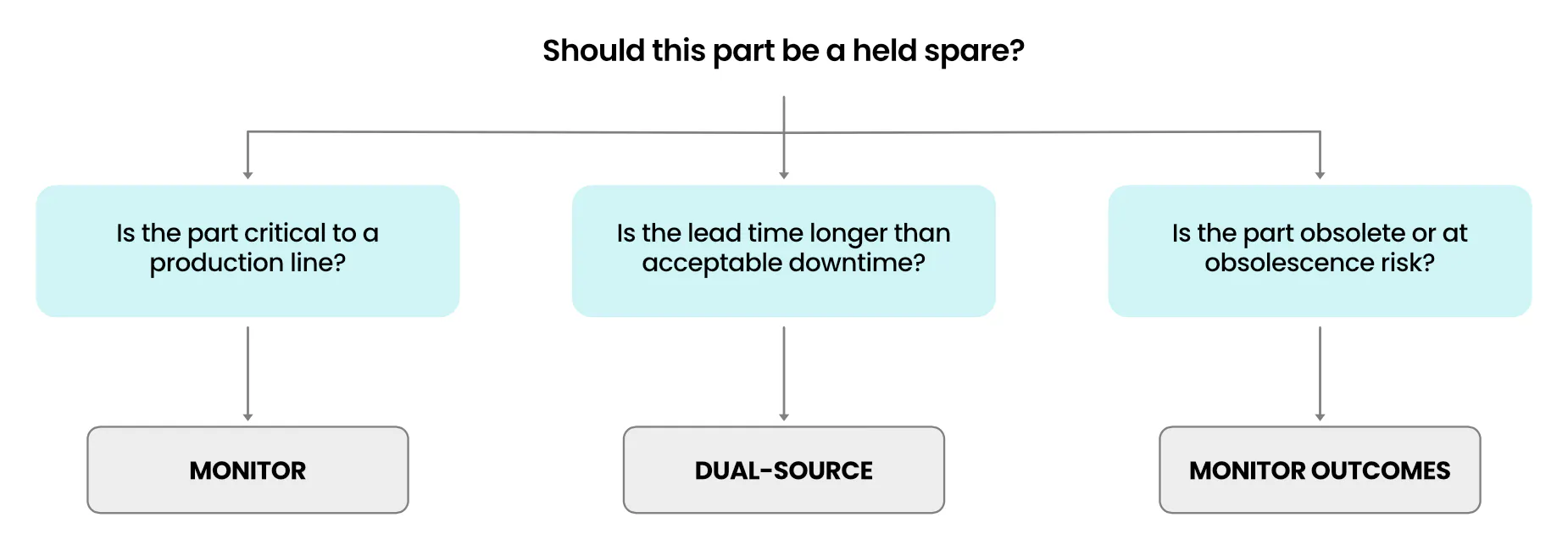
This is where sourcing and procurement meet. A predictive maintenance programme can forecast when a component will fail, but that forecast only delivers value if the part can be sourced within the window it provides.
EU Automation supplies current and obsolete components to meet exactly these procurement windows, so a planned replacement is not held up by an unavailable part. For the obsolete long tail in particular, having a reliable source of discontinued parts is what lets a plant run its assets to a sensible end of life rather than replacing them early out of supply anxiety.
A practical sourcing strategy framework
A sourcing strategy does not need to be elaborate to work. It needs to be written down, based on real data and reviewed as the supply chain moves. The following framework pulls the preceding sections into a sequence that a plant can follow:
- Build a criticality ranking of components, scored by the cost of the line stopping if each one fails.
- Record the real lead time for every critical part, from order history rather than supplier quotes.
- Flag every component that is obsolete or approaching end-of-life, using the manufacturer’s status and field experience.
- Decide the sourcing route for each critical part: held spare, dual source, repair path or planned upgrade.
- Qualify a second supplier for the parts where a single source is too much risk.
- Set buffer stock levels for the highest-criticality, longest-lead-time components, and no further.
- Review the plan on a fixed cycle, updating lead times, obsolescence status and stock levels as they change.
The framework is deliberately ordered by risk. Criticality comes first because it decides where the effort goes, and a plant that cannot stock everything should stock the few parts whose absence would cost the most. The rest of the strategy flows from that ranking.
Conclusion
Disruption is no longer the exception that a plant can plan around once a year. With major supply shocks now a regular feature of industrial operations, the difference between plants is how ready they are when a part runs out. Readiness comes down to three questions answered in advance: can the component be obtained, how fast and from how many sources. Automation parts make all three harder, because they are specialised, long-lived and prone to obsolescence.
The best sourcing strategies turn those questions into routine decisions instead of emergencies. Rank components by criticality, base lead times on what really happened rather than what was quoted, flag obsolescence before a part fails and stock only the spares whose absence would cost the most.
Handled this way, a discontinued component becomes an inconvenience rather than a crisis. EU Automation supports that approach by supplying current, hard-to-find and obsolete industrial automation components, helping plants keep critical lines running while they plan modernisation on their own terms.
References
[1] https://resilinc.ai/press-release/global-supply-chains-see-nearly-40-annual-increase-in-disruptions/
[4] https://www.mckinsey.com/capabilities/operations/our-insights/supply-chain-risk-survey-2024