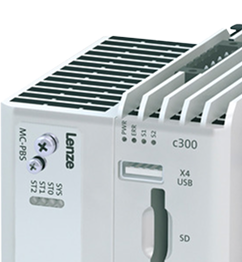
What is the purpose of the Lenze communication module?
The Lenze communication module is designed to facilitate PROFIBUS communication between a control system and Lenze drives. It supports PROFIBUS-DP-V0 and PROFIBUS-DP-V1 communication profiles, allowing for both cyclic and acyclic data exchange.
Can the communication module be used with different baud rates?
Yes, the module automatically detects and supports a range of baud rates from 9.6 kbps to 12 Mbps, ensuring compatibility with various PROFIBUS network configurations.
How many process data words can the module handle?
The module can handle up to 12 process data words, depending on the capabilities of the basic device it is connected to.
Is it possible to access parameters acyclically with this module?
Yes, the module provides acyclic parameter access via the DP-V1 profile, allowing for the reading and writing of parameters outside the regular communication cycle.
What kind of power supply does the communication module require?
The module requires an external 24V DC supply, which also allows it to maintain the PROFIBUS network if the standard device fails.
How can the node address be set on the module?
The node address can be set using the DIP switches on the module, providing a simple and effective way to configure the device's network address.
What do the LED status displays on the module indicate?
The LED status displays on the module indicate the voltage supply to the module, the connection status to the PROFIBUS network, the connection to the standard device, and the operating statuses of the standard device.
Can the module be used for identifying the standard device?
Yes, the module supports the I&M0 functionality, which is used for identifying the standard device within the PROFIBUS network.
Is it possible to maintain communication if the standard device fails?
Yes, the module's external 24V supply can maintain the PROFIBUS network communication even if the standard device fails, ensuring network integrity.
How does the module support different drive profiles?
The module supports different drive profiles by allowing the DRIVECOM profile 'drive technology 20' and the PROFIdrive profile to be switched on or off, depending on the requirements of the application.